Tuesday, January 8, 2013

LOOKING FORWARD, LOOKING BACK


With crystal balls in short supply, looking forward is at best speculative, and at worst purely wishful thinking (New Year's resolutions anyone?)  Still, with the refreshing picture of turning over a new leaf that the flip from 31st December to 1st January brings to mind, we all like to indulge ourselves in the somewhat bipolar activity of reviewing the old and anticipating the new.

In terms of the new, if the recent influx of joggers, walkers and cyclists in the streets is anything to go by, many of us are embracing the New Year: New Me idea.  Not least among them I too have vowed to get more exercise, adopt not just one but two AFD's (alcohol free days) per week (gasp!), bitch less and empathise more, write in this blog regularly (ha! I hear you say), not take criticism and rejection personally and other such absurdly unrealistic, not to mention unoriginal, figments of someone else's imagination.  What's important about any of it I suspect is that it keeps us subscribing to the idea that, with sufficient motivation and determination, we can take control of our lives, notwithstanding those hefty slabs of it that are beyond our grasp.  Reaching however never did anyone any harm and illusory though the concept of self revitalisation may be, it  feels good to give it a shot.

A friend of mine recently adopted the phrase "shameless self promotion" in describing her venture to put her current, very exciting writing project, as they say "out there", by means of a personalised website.  At the risk of being (again) unoriginal, I'd like to take a similar approach (ideologically at least) to my own writing.

What this means is convincing myself, first of all, and then that many headed monster, the market, that I've got something worth selling.  My natural instinct has always been to hide my light under a bushel (whatever the hell a bushel is), a practice that leads to fumbling in the dark and getting stepped on.  

Shameless of course implies being prepared to let it all hang out, without fear, timidity, anxiety or any of those other self-defeating inhibitions I imbibed at my mother's knee.  It means letting go of the idea that trying to flog your work implies seeking favours to which you're not really entitled, embracing the idea that if I think my work has merit, I shouldn't let anyone else convince me it hasn't, and finally abandoning for ever any fantasy of achieving perfection.

As much as the ability to string words together, a writer needs persistence; that vastly underestimated quality that probably takes you further than any other.  I recently found a perfect (ok, pretty good) analogy for the persistence a writer needs in a quote from Edward Hoagland's "The Courage of Turtles".  Here it is:

"Turtles .... don't feel that the contest is unfair;  they keep plugging, rolling like sailorly souls - a bobbing, infirm gait, a brave, sea-legged momentum - stopping occasionally to study the lay of the land."

So for me, it means cut the whingeing and whining, stop resenting other writers' successes, forget expecting anything to be fair, listen to valid criticism and let the rest roll off like the proverbial duck and reminding myself every day that writers write.  Pausing, like the turtle, every now and then to take stock is allowed.  Stomping off in a huff, thinking I'm a loser isn't.  It's as simple as that really.

I haven't devoted any space here to reviewing the old, but if you've read previous versions of the blog you'll pretty much know last year was a biggie, in that I got married, practically finished off my Masters and moved gratefully into semi-retirement, which pretty much sums it up.

At this time of year, the coming months shine with promise, especially as we surge forth renewed and optimistic.  I don't know what will unfold but I doubt I'll get many clues from crystal balls, astrological charts or Chinese horoscopes and if ever I'm tempted to waste time looking, I hope I remember this quote from Shakespeare

"The fault, dear Brutus is not in our stars.
But in ourselves, that we are underlings."

Underlings arise! Let's make 2013 the year of shameless self promotion!!

Sunday, August 5, 2012

A Room with a View

I’ve lived in a variety of residences over the course of my life so far, and have liked some more than others.  In none of them have I yet been able to create what I call the perfect room.  Such a space is somewhat resistant to definition, but I know I’ll recognise it when I see it.  There is possibly only one non-negotiable feature, and that is a view. 

On the assumption that most rooms have a window, it can reasonably be assumed that most rooms have a view of something, even if only the neighbour’s galvanised iron fence.  What I have in mind however is a vista.  This means, at least to me, a panorama; a landscape, seascape, treescape or hillscape to enchant the eye.  A streetscape won’t suffice, although I could make an exception for the Champs Elysees. 

It must be something about the drawing out of the visual field, the possibilities conjured by the ability to look to a horizon beyond your immediate reach.  My reach has ever exceeded my grasp and distant fields have always looked greener, but it’s more than that.  Opening a physical window to the world serves to open the mind and the imagination.  What is that speck far off in the distance?  A man, a wildebeest, or just that damned floating vitreous again? 

Focusing on something distant works, paradoxically, to sharpen that much more intimate perspective, my thoughts.  The view seems to spark off a simultaneous process of inspection and introspection.  As a writer I read recently said, to paraphrase, attempting to see anything past the racket in my head is often futile, so whatever helps that process is good.  To paraphrase yet again, there is something to be said for a room of one’s own, but a room with a view is infinitely superior. 

This was just what greeted us as we entered The River House, a bed and breakfast establishment on the banks of the Tamar River just outside Launceston; our next port of call after leaving the Bay of Fires.  From what I had read of the place beforehand, it promised to be good.  However, as anyone who’s used the Internet to book accommodation knows only too well, lyrical self-promotion and stunning photo galleries can often be misleading.  Not in this case though. 

The River House is a gracious building set in an expansive garden which on one side slopes down to the Tamar River, affording the guest rooms sweeping views of the river frontage.  The house was originally a family residence, to which substantial additions, renovations and refurbishments have been made, to brilliant effect, over the years. 

On our arrival we were welcomed by the host, Carl, a charming man who made us feel at home immediately.  Although having established himself in the hospitality industry only later in life, Carl has taken to his role (not to labour any puns here) like a duck to water.  Not only has he mastered the art of anticipating his guests’ every need and ensuring it is promptly met, but he manages to do so in the calmly unobtrusive and unselfconscious manner of an old friend. 

Leading directly off the entry foyer where the business side of arrangements are conducted, is the guest lounge, into which Carl ushered us once the formalities were out of the way.  This was the room with the aforesaid view, the room that was made for me, or should have been.  It was large, spacious, furnished with solid, comfortable, people-friendly sofas and chairs, and one wall of it looked directly out over manicured lawns, native shrubs, statuesque gum trees and the broad expanse of the river flowing past just a few yards away.  Along one wall a welcoming fire roared in the large stone fireplace.  This faced another wall lined entirely with books, which as anyone who knows me is aware are my favourite things in the world.  The concept of a desert island book is one I find impossible to envisage.  There's no way I’d survive anywhere without a security blanket of at least several dozen. 

In terms of the room, about which I am being so unashamedly effusive, there was nothing about it that would necessarily strike others as impressive; no delicate fabrics, priceless antiques, cutting edge design, gleaming or glamorous ostentation of any description.  Subtlety was probably a large part of its charm, that and taste, the acquisition of which of course, is not guaranteed by the heftiest budget.  It was very much the view, but also the open fire, the bounteously stocked bookshelves, the broad chunky coffee table, the elegant lamps, the comfortable chairs and the ... well all of it.  All the elements combined discreetly and seamlessly to create an ambience of peace and comfort that seemed perfectly effortless.  It was the sort of place where you’re tempted to start spouting rubbish like all I need is a jug of wine, a hunk of bread and thou, so long as it’s here, and I’ll be happy forever.

No sooner had we deposited our belongings in our room, freshened up and re-oriented ourselves to our new abode, than Carl had conjured up a pot of tea and some home-made apricot slice which he set out on the table in the guest room “in case we might feel like it”.  Naturally after driving all day, we did, and it was a delight to sit back and relax in the lovely surroundings.  Tea eventually progressed to an evening refreshment of stronger kind and as we appeared to be the only guests in residence we were fortunate enough to have the guest room to ourselves to observe the gradual onset of dusk over the garden and the river outside. 

As the shadows lengthened and crept towards the house, the river seemed to slow, along with the day, and take on a different persona, darkening and merging into its surroundings.  Like rooms, there can be something magical about a body of water, changing and transforming itself constantly in response to the fluidity of the light over and around it.  Looking out at this, I noticed within the shadows some deeper shadows that moved.  These turned out to be wallabies, many of which live around the house and adjacent properties and come out to graze on and in some cases gobble far more than they should of the grass and shrubberies.  Hard to see them as pests, with their sweet, doe-eyed faces, however they can obviously outstay their welcome, to the extent, Carl told us, they sometimes end up as wallaby pie.  He and his wife, we were pleased to know, don’t discourage their marsupial visitors, seeing them as adding a bit of local colour, which they clearly do. 


When we woke the next day it was to a transformed world.  A feathery grey blanket lay heavily all along the river, a not uncommon phenomenon apparently on autumn and winter mornings.  Because the house was situated so close to the river, the mist had expanded over the garden and everything outside the window seemed shrouded in a dense grey cloud, through which the silhouettes of bushes and trees could be discerned only vaguely.  If any early rising wallabies were out there breakfasting, they would have been well camouflaged. 

As we ate our breakfast, which lacked for nothing, and was enhanced by the convivial company of Carl popping in and out to ensure we were nothing less than completely satisfied, the mist lifted slightly from the garden but still hovered persistently over the river.  We discovered later, when we set off down the highway which runs parallel with the river, the fog extended all along the estuary which stretches for some 70 kilometres.  Because of the topography of the Tamar River valley, the area is renowned for fog which can play havoc with air and sea traffic in and out of Launceston.  Indeed Launceston has the dubious honour of being the most fog-bound commercial airport in Australia.

It was with considerable reluctance that we took our leave of the River House and Carl.  We didn’t meet his wife, whose role appeared to be confined to chief cook and bottle washer in the kitchen, however she certainly cooked a mean breakfast.  No doubt the economic downturn has impacted on the tourism business and sustaining a small business in the industry in such times would be difficult.  Carl is therefore keen to attract as much custom as possible, and encourages his guests to submit reviews of his establishment on Trip Advisor, providing they are favourably impressed, and I can’t imagine anyone who wouldn’t be.  I was only too pleased to do this of course and would urge anyone who is looking for somewhere spectacular to stay to try this lovely spot.  Compared to other places of comparable standard, the River House is also extraordinarily good value for money.

To check it out go to:

http://www.tripadvisor.com.au/Hotel_Review-g1488917-d1487223-Reviews-The_River_House-Dilston_Tasmania.html

Hopefully we will return one day for another taste of gracious riverside living.

Wednesday, July 18, 2012

Say Cheese


As a child I wasn’t much enamoured of cheese.  Not surprisingly, given that about the only commercially available variety in those simpler times was Kraft Cheddar.  This, for those who can remember and those who can’t, was a block of processed rubbery material encased in a colourful blue cardboard wrapper.  Those who have feasted on it will never forget its uncanny resemblance to soap, in both texture and taste. 

There may well have been a wider selection available but this was the only one that made it to our table.  In fact by the 1960s there were around 20 cheese varieties being produced in Australia, a quantity that was to double in the next ten years.  So it may just have been that Mum was an unimaginative shopper, or a slavish brand follower.

Something else from those times that can’t be forgotten is the old admonition whenever a camera hove into view, to say Cheese!  While the stuff itself was unlikely to bring a smile to childish lips, its articulation demanded it.  Rebellious kids probably gave it a shot, but it’s pretty well impossible to say the word, given its obligatory stretching of the lips and baring of the teeth, without giving the appearance, at least, of smiling.  It wouldn’t work in French of course.  Fromage doesn’t cut it in the facial grimace stakes, despite the suggestiveness of that husky rolling “r”.  Happy snappers in France apparently encourage grinning in their subjects with the request “dit souris”, (say mouse); not too far a stretch when you think about it.

Smiles and mice aside, cheese was very much on our minds when we visited Pyengana in Tasmania, not far from St Helen’s and requiring only a minor detour from the route that would take us to our next destination.  The Pyengana Dairy Company has been making cheese for the last hundred years or so.  There was therefore good reason to believe they had perfected the art. 

 Some distance from the esteemed cheese making establishment, the scenery began to take on a distinctly pastoral appearance.  Situated in a river valley, the region is climatically perfect for the rearing of dairy cattle.  Some of the brochures we’d read described the countryside in these parts as “lush”, a word that struggles to do justice to the picture postcard gorgeousness of the scene that unrolled itself before us.  Beethoven’s Symphony No. 6 could have been composed with precisely this little spot of cow heaven in mind. 


The Pyengana Dairy Company has, to its credit, capitalized on the Tasmanian foodie tourism trend and set itself up well to capture the interest of passing travelers.  It has an attractively presented shop of course where one can buy in addition to cheese, a variety of cow related objects, spanning the spectrum from eclectic to kitsch.  The cheese offerings include a commentary by the assistant (with samples) on the range of cheeses manufactured.  There is also a café called (what else) the Holy Cow.  It is all tastefully done with a minimum of crass commercialism and a view to die for from the Holy Cow café, which looks out on the surrounding pastureland and the original cheese producers – the contentedly grazing cows. 


Having discovered as I matured (like a good cheese) that the world of cheese is not as insular as my early Kraft Cheddar years suggested, I must confess to now being an unregenerate cheeseaholic.  My judgement in regard to cheeses is therefore possibly suspect, in that I pretty much love them all.  At Pyengana they specialize in cloth-bound mature cheddars, ranging from mild (matured for up to 6 months) to mature (12 months and more).  There are also flavoured varieties, including “devilish” (spiced with chili) which is a popular choice.  After sampling them all, I found it hard to go past the ultra mature cheddar, which although bitey, as one would expect, had a mellow and almost silky texture, rather like fine chocolate, or wine.


As there was an inviting open fire and the aforementioned view, we decided to stay for lunch in the Holy Cow Café.  In between ordering and partaking, David decided to step outside for a first-hand look at the producing side of things.  As he was born and raised on a dairy farm at Woodside in the Adelaide Hills, he harbours some nostalgia for those days, notwithstanding the rigours of early morning milking and other such delights.  He was therefore keen to see to what extent progress had caught up with the industry.  By the time he returned, lunch had been well and truly served and mine, which was delicious, already consumed.  It would be a pleasant life, I imagine, tending the cows and mixing up the curds and whey, especially in such delightful surroundings, however life on the udder side sometimes looks better than it is. 

And now that every suburban supermarket seems to boast a specialised cheese counter to rival the best of the old David Jones’ Food Hall days, there must be so much competition for the consumer dollar that small companies such as this no doubt work very hard to make a profit.  It is gratifying to see that they are able to do this in Tasmania and not only survive, but maintain such high quality products over so many years. 

Saturday, June 30, 2012

Bay of Fires


As far as eateries go, Binalong Bay boasts only one, so the burden of choice was minimal as we drove into the small beachside town right on lunchtime.  The solitary cafe is, as we discovered, excellent, superbly located with a million dollar outlook over the southernmost stretch of the famous Bay of Fires.  As we approached, it looked like there might be a bit of a line-up, hardly surprising in a one cafe town at lunchtime, so we prepared to get behind the couple who were waiting outside the door.  What they were hoping for wasn’t sustenance however, but an elusive network connection.

“No, nothing.  Dead as a dodo,” the middle aged man said gazing despondently at his phone which he’d been waving around in the briny air.  Spotting David’s IPhone, he said, “You’re not on Optus are you mate?”

“Well, yes,” David replied.  “Why?”

“Have you got any bars on yours?”  He wasn’t referring to drinking establishments but those little symbols on the screen that show the strength of your connection to the network.  Which had, as it turned out, entirely disappeared from David’s phone as well.

“See, there you go,” he said, turning to the woman with him, who judging from her expression of resigned forbearance, must have been his wife.  “Pathetic.  We’ve been travelling along the coast for the last five days and can’t get a connection anywhere.  What kind of service is that?”

We commiserated with him, as we were obviously expected to do, even though we hadn’t suffered quite the same degree of inconvenience.  Apart from a few fadeouts, our connection had been reasonably reliable until we arrived at Binalong Bay.  This bloke wasn’t in the mood to be placated however.  He seemed to take it as a personal insult that his carrier of choice was failing to deliver and what’s more no-one had warned him.  He’d been left in the lurch with no means of communication, other than, heaven forbid, a landline.  Almost enough to make you switch over to the big T, and perhaps he was planning to do just that. 

Optus has indeed been a non-presence in many parts of Tasmania, where Telstra has maintained a monopoly for some time.  In the spirit of competition however, about a year ago Optus announced a major investment in expanding their coverage and this, it is hoped will improve the situation.  In the meantime, Optus customers who visit patchily serviced areas like this section of the east coast, have to make do with old world technology, or resort to archaic holiday practices like sending postcards.  Another one of those what did we do before Gladwrap scenarios. 

The last we saw of the disgruntled pair, they were munching their takeaway hamburgers on a bench overlooking what Lonely Planet named the world’s “hottest” travel destination in 2009.  Hopefully they got over their pique about Optus and were able to fully appreciate it.

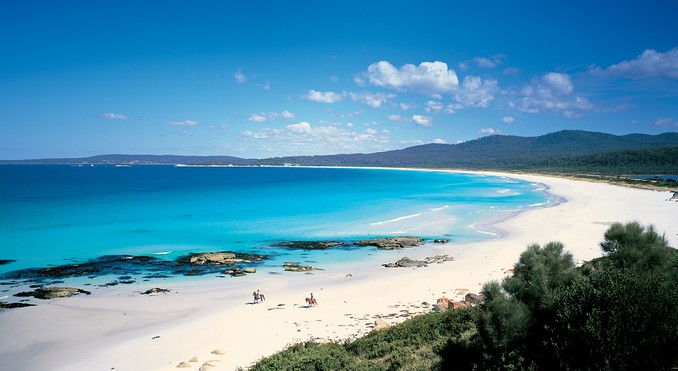
Lonely Planet’s article painted a vivid picture of “white beaches of hourglass-fine sand, Bombay Sapphire sea, an azure sky – and nobody.”  This is just how it was when we were there.  In the height of the holiday season it may be different, at least along the stretch adjacent to Binalong Bay, where it is closest to civilisation. 


The Bay of Fires stretches from Binalong Bay north to Eddystone Point, a distance of about 56 kilometres, with part of the northern section included in the Mt William national park.  It was named not for the fiery colour of the rocks that border much of the shore, but by an early explorer, Captain Tobias Furneaux, a crony of Captain Cook who sailed along the coast in 1773 and spotted many fires burning along its length.  These were the fires of the local Aborigines who were numerous at the time, as evidenced by the many middens (shell and bone deposits) which can still be found in the sand dunes.  Whether they were roasting kangaroos for dinner or just trying to frighten off the approaching invaders isn’t known.  What is known is that the Aboriginal relationship with fire, like their connection to the land, was an integral part of their culture and mythology. 

There are a number of tour operators that conduct guided walks along the full extent of the bay.  It is about a three day trip, with overnight camping, offering varying levels of communion with nature, from the elemental to the luxurious.  Depending on your budget and willingness to get up close to nature in the raw, you can have a spiritually cleansing experience, forfeiting showers, soft beds and other such comforts, or a relatively civilised one where the encounter is cushioned by such rituals as afternoon tea and scones. 

Time not permitting, we didn’t pursue the full Bay of Fires experience on this trip, although it is definitely something to include on the longer term “to do” list. 

What we did see of it lived up to the Lonely Planet hyperbole.  Even on a grey and cloudy day, which it was when we first arrived, it was picture postcard material, with the whitest sand I’ve ever seen, turquoise waters of a limpid blue and the aforementioned orange lichen covered rocks, which lie like gatherings of great sleeping beasts between the shore and the land.  So entranced was David by the first sight of these, he sprang from the car and in no time was leaping from peak to peak like a mountain gazelle.  Not to be outdone, I followed, forgetting I have zero sense of balance and my leaping days are long gone.  I ended up horizontal in a short space of time, but fortunately David was too busy doing his king of the world impression from the top of the highest rock to notice. 


 When we awoke the next day, it was to one of those lustrous mornings when the world looks like a newly minted coin.  Everything gleamed.  The sun shone in a brilliant blue sky.  The sea sparkled, and the long curve of white sand curled away into the far distance.  Our accommodation was, although not five star, spectacularly situated, on a hill looking straight out over the sea.  Far along the beach we could see, from our bedroom, a couple with two Labradors walking along the shore.  To say the dogs were enjoying themselves would be a huge understatement.  Those two were in dog heaven, gambolling about, frolicking in and out of the water, chasing birds, kicking up sand and having one hell of a time.  Not too shabby a place to enjoy a morning walk.  We couldn’t help but think of Lottie and Fergus, cooling their heels in the boarding kennels, no doubt wondering whether they’d been abandoned for life.  It’s a good thing they didn’t know what they were missing.


This is another of the breathtaking places for which Tasmania is so renowned.  Despite it having been publicly rated on a par with the best the world has to offer, the amazing thing about the Bay of Fires, as is the case with many of Tasmania’s attractions, is that it is still so unspoiled and seemingly immune to the depredations of over-commercialisation.  Let us hope it remains that way.


Thursday, June 21, 2012

Oysters


If you eat snails, frogs’ legs, brains, sheeps’ eyes and other assorted gruesome gunk, you are likely to be a devotee of oysters.  What all these morsels have in common, it seems to me, is a certain quality of slime that should render them unfit for human consumption. 


On the contrary, they are highly sought after delicacies and among them the oyster may well be considered the consummate confection.  This might have something to do with its reputation as an aphrodisiac.  Casanova is alleged to have consumed fifty of the little blighters a day, but to my mind this doesn’t prove anything.  He was clearly just a bloke who never knew when enough was enough.  Scientific theories for the mollusc’s alleged libido boosting powers abound.  Although, as with most scientific theories, there has been no general consensus, it is thought that the abundance of amino acids and high zinc content may stimulate the production of testosterone.  I’m not sure whether any studies have been done.  No doubt there’d be plenty of aspiring Casanovas eager to offer themselves as research subjects.   

Notwithstanding hormonal surges or the lack thereof, the number of ostreaphiles (oyster lovers) in the world is still high.  Indeed, according to some pundits, the slimy morsels are experiencing a resurgence in popularity.  This must come as good news to Tasmania’s oyster farmers, a number of whom operate out of St Helen’s, on Tasmania’s east coast.  St Helen’s lies between Bicheno and Binalong Bay and as well as being known for its oysters, it is promoted as the game fishing capital of Tasmania.  We passed through here on our way to Binalong Bay, and as we approached the town were attracted by a throng of fishing boats of all shapes, sizes and colours tied up at the wharf in George’s Bay.  Even for those, like us, whose closest encounters with fishing have been hanging a line over a jetty once or twice in our youth, there is something fascinating about fishing boats, so of course we had to have a closer look. 


Not far outside the town was a large oyster farm, at which there was little evidence of oysters, but presumably they were growing away beneath the surface. 


Other than the occasional oyster Kilpatrick, I am not an oyster aficionado and certainly not appreciative of their au naturel qualities.  Those who are say gulping one off the shell is like that first zingy plunge into the sea.  To me it feels more like coming up with a mouth full of seaweed.  Size counts too.  They don’t want to be too big, otherwise, as the novelist Thackeray is reported to have said, you may end up feeling like you’ve swallowed a baby.

As I am not only an ostreaphobe but a fishophobe as well, the marine harvesting activities of St Helen’s were a bit lost on me.  However it is good to see how areas of Tasmania such as St Helen’s are really capitalizing on their pristine and unspoiled environment to produce some of the highest quality foods and wines in the nation, oysters being just one of these.  This is giving a much needed boost to the tourism industry, with the island now being strongly (and deservedly) marketed as a foodie paradise.  So, despite eschewing the fruits of the sea, I was able to indulge in plenty of other gastronomic treats, about which more later.


Monday, June 18, 2012

Beach Dreaming at Bicheno


At Bicheno, our next stop after Ross, we spent two nights in Sandpiper Cottage, just a few steps away from a gorgeous beach populated by the cottage’s namesake birds.  Bicheno is a popular seaside resort on the east coast of Tasmania, attracting many tourists in the summer.  This being late autumn, tourists were thankfully noticeable by their absence.  There is something about the beach out of season.  It’s a world apart from its hot, sandy, noisy and crowded summer counterpart and for that reason vastly more appealing to me. 

 When I was a teenager, going to the beach was what you did unless you wanted to be thought of as weird.  In retrospect, I’m pretty sure I was weird but just too cowardly to advertise it to my peers.  So, although I knew from bitter experience that spending a day basting myself on the sand in the blazing heat of summer would be an agony of embarrassment and discomfort, I went along meekly for the ride.  The bane of my life back then was my fair, freckled and sunburn prone skin, most of which I still have, apart from a few chunks sliced off by dermatologists over the years.  Ignorance about the effects of sun damage was our excuse of course.  Even if we’d known however, I suspect that in the spirit of the times, we wouldn’t have cared.  Not only had the word melanoma not entered the lexicon, the precautionary principle was as foreign a concept to us as safe sex.  Back then, being brown was not only fashionable it was mandatory.  Cocoa was the shade of preference. Toffee, coffee, honey and gold were okay options as well.  You could possibly scrape by with an orange fake tan if it wasn’t too streaky or smelly.  Failing all else, shades of lobster or tomato would do.  What you could never be was white.  Forget sun bathing, you had to fry.  Covering up was not an option, unless it was with oil.  Oily and tanned is an okay look I suppose.  Oily, white and skinny is not, unless you’re an oven ready chicken.  In my case, after an hour or so of baking, liberally anointed, the chicken turned to frazzled bacon. 

 In quest of the body bronze or as near to it as you could get, the routine was to hit the sand along with the rosy fingers of dawn and stay there immobile until the golden rays dissolved into dusk, along with your fried brains.  Apart from anything else, it was boring, sweaty and gritty and left me with a lasting loathing of the beach in summer.

 The beach we discovered outside our back door at Bicheno was nothing like that.  It was an enchanted vista of silvery water, brooding sky, softly shadowed sand, and blessed isolation.  No people, no pressure to be black, brown or brindle and thank goodness no oil.  The only sounds were those of the waves, the birds, and the breeze rustling the sea grass. 

 Apart from a few trails of footsteps and paw prints, there was nothing to show anyone but the birds frequented this lovely place.  Each time we walked along it we didn’t encounter another soul.  That is unless sandpipers have souls, and there’s no reason to suppose they don’t.  It was funny to watch these little fuss budget birds, a constant whirl of motion, as they fossicked busily, pecking, probing and darting from one spot to the next.  So quickly did they scamper along the tide line, their little legs twinkling, they seemed to skim like miniature skaters across the surface. 


You can see forever on a beach like this, as far as you want to look, ahead, behind, above, down at your sand covered feet, or away to the far-off point where the distant hills fold away into the sky.  There’s scope here in the vast tranquil space, to just be, to let go what's gone and surrender yourself to what's to come.  There seems for a brief while at least nothing else to want or need.  For us, Sandpiper Cottage at Bicheno was a special place - one of the highlights of our trip.


Thursday, June 7, 2012

Ross, Tasmania


Our second stop on our Tasmanian holiday/honeymoon (following Launceston, site of The Wedding) was the town of Ross. Although a spot worth visiting for its charm and historic sites alone, our visit was also prompted by my desire to wallow in a bit of nostalgia.  The last time I had dropped in there was some thirty seven years ago.

 Not much has changed, almost it seems since the 19th Century, let alone since I was there.  Even so, it took a while for me to re-orient myself.  At first although I’d lived in it for a time, I didn’t recognise the handsome house in the photo above, not remembering it as white and also thinking it was at the other end of the street.  It had been a while.  However there it still was, “The Scotch Thistle Inn”, originally a Georgian coaching inn, later a restaurant and now a private residence. 

 When I lived there, the ground floor was the restaurant where I slaved over a hot stove nightly as the chef.  Upstairs were the living quarters, where I cohabited with the owner of the establishment.  Not so much a case of mixing business with pleasure, as a relocation of a relationship already begun in Adelaide.  He had bought the place on impulse while we were on holiday in Tasmania and gallantly invited me to move over and help him run it.  Holiday impulse buys for most people usually consist of scarves, stuffed wombats and the like, but not this chap.  He bought a lifestyle and a livelihood in one. 

Despite flying by the seat of my pants I somehow managed to satisfactorily feed whoever wandered in.  On busy days this could be as many as fifty people, on slow days as few as one or two.  Life being what it is, you could be sure the multitudes would descend on just those days when I least cared to welcome them, but in the hospitality game you just keep smiling.  Challenging though the cooking was, it was nothing compared to scraping grease off the monster of a coal fired grill at midnight, cleaning the toilets on a freezing cold Tasmanian morning, or retrieving our slightly mad red setter from his wild rampages through the local handicraft shops. 

Still, it was, as they say an experience and no doubt character building.  On our recent visit, David and I stayed in a very quaint but cramped cottage, the best features of which were the very efficient combustion heater and the port.  With the demise of the Scotch Thistle Inn as an eating place, there are not many alternatives for diners these days.  We ended up at what seemed to be the only place, apart from a takeaway food joint, which was the Man O’ Ross Hotel, a worthy establishment which has graced the town since it was first built.  The dining area was big on local colour in the form of corpulent blokes in Hi Vis attire devouring mountains of chips, but lacking in historic quaintness and charm, which was a shame.  Despite its venerable history and gracious exterior, inside it is just your basic no frills Aussie pub.  Room for some entrepreneurialism there.

We visited the famous convict built bridge of course which is beautiful, and the wool centre, where thankfully the proprietors have changed since the mad dog and I were last there.  The streets were mellow and glowing with autumnal colours and old sandstone wherever you looked.  We sampled the bakery’s wares and were most impressed, and in my case splattered with sauce when my plastic cube of Heinz malfunctioned.  God I hate those things.  Then we went on our way, leaving behind us a delightful little place that time seems to have forgotten, but not I, having now some newer memories to enrich the older ones.